
Beyond Bleaching: What Corals Teach Us About Resilience
This story was written by Tashu Wadhwa and Anurag Srivastava and edited by Melissa Pappas and Eisha Mhatre.
When we picture corals, we often imagine bright reefs under clear waters — dense, colorful and alive. But a coral is much more than its beauty. Each coral is made up of tiny polyps, soft animals related to jellyfish and no bigger than a grain of rice. Over decades, these polyps slowly lay down a calcium carbonate skeleton beneath their fleshy bodies. What looks like scenery is actually living infrastructure: a foundation that shelters fish, plankton, turtles and thousands of other species. Corals are silent engineers, shaping some of the most diverse ecosystems on the planet.

At the same time, these powerful engineers are deeply sensitive to their surroundings, and their health mirrors the health of the ocean itself. Because corals respond quickly at a physiological level to environmental change, they are often framed as indicators of a shifting climate. But focusing only on what corals signal can obscure what they actively do to adapt, reorganize and sometimes survive under extraordinary stress.
Climate headlines about warming seas, intensifying storms and shifting seasons can feel abstract. Corals make those changes visible. Bleaching, disease and habitat loss are some of the most striking ways reefs reflect climate change and other human-driven stressors. Yet even these dramatic visuals are often not enough to inspire action. For coral science and conservation to move beyond academic circles, the biological and ecological processes unfolding inside these ecosystems must be understood, communicated and connected to everyday experiences — ones that place common people at the center of the story.

Corals, and the ecosystems they build need better PR. We need to use metaphor, storytelling, and shared experiences as tools to connect people to systems they may never see in person. One way to do that is to flip the script.
Coral reef science is most often associated with tropical coastlines, which can unintentionally leave people staying further from those places out of the conversation. How can someone from the Arctic or the Arabian desert be interested in conversations on corals? To bring them back in, we need to highlight a different side of coral science — one that connects to their own geography, time and daily lives.
One way to do this is by highlighting unexpected places where coral research is happening. Did you know of arctic corals that thrive in the dark, frigid waters of the Arctic ocean around Norway, Greenland and Canada? Or the unique heat-resistant ‘super corals’ found in the Red Sea near Saudi Arabia? However unexpected these places might be, in these settings, corals are being removed from postcard imagery and treated as living systems — cultivated, observed, and explained in ways that invite new audiences to engage with how reefs and individual corals function.
Just as importantly, framing coral research in these locations shows future ocean researchers what is possible in their own regions. It opens doors to studying marine organisms in places where one might not think it possible and highlights how coral research contributes far beyond reef ecology alone. This story is one example of how coral science can be made more accessible to scientists, students and ocean enthusiasts, no matter how far they live from the coast.

The Women Studying Corals in Unexpected Places
Challenging the assumption that you need to live near a tropical reef to study corals are two scientists working in desert environments: Dr. Liza M. Roger, Assistant Professor at Arizona State University’s School of Molecular Sciences and School of Ocean Futures, and Dr. Raquel Peixoto, Professor in Marine Science at King Abdullah University of Science and Technology (KAUST). We invited them on our latest Art X Science Conversations webinar to share their research and the questions and curiosities that draw them to corals.

Liza’s path into coral research began in childhood, watching Jacques Cousteau documentaries — her first window into the ocean. She entered marine science through research on calcifying sea snails and sea slugs called pteropods, studying how these tiny organisms record environmental stress in their shells. That training in chemistry and cellular signaling gradually led her toward corals, where similar questions about resilience and physiological breakdown play out at a larger, more complex scale.
Today, Liza studies how coral cells communicate with their symbiotic algal partners and how that fragile relationship breaks down under heat stress. She does this from a landlocked lab in Arizona.
“I found a niche improving coral cell culture techniques to understand how corals and their symbionts keep this fragile partnership balanced under stress,” she explains.


Raquel came to coral science from a different direction. Trained as a microbiologist, she first worked with beneficial soil microbes and later on mangrove bioremediation while using living organisms, such as bacteria, to remove pollutants from the environment. Over time, her work shifted fully into coral research.
Now based on the desert coastline of Saudi Arabia, Raquel focuses on coral probiotics and the role of microbial communities in helping corals recover after heat stress. Her research takes place in the warm, salty waters of the Red Sea.

The Challenges of Studying Corals in Desert
Deserts are often imagined as barren landscapes, but both Arizona and western Saudi Arabia host surprisingly rich ecosystems:cacti that shelter birds, migratory corridors that come alive after rain and mountain regions where winter snowfall is common. These environments already model survival under heat, scarcity and extremes, making them fitting analogies for coral research as well.
For Liza, the biggest challenge isn’t the absence of an ocean but people’s assumptions about what marine science should look like.
“There’s this misconception that you need to live by the ocean to do marine science,” she said, pointing out that many major marine programs exist far from coastlines.
At ASU, her team grows corals in the desert, creating seawater through a carefully balanced mix of deionized water, reverse osmosis and commercial sea salts.
“It’s a demanding system,” she admits. “Without natural seawater microbes, corals need extra monitoring, and even a minor imbalance can skew results.”
Working in a desert also means thinking carefully about water use and disposal. Her lab collaborates with health and safety teams to ensure that their artificial seawater systems are sustainable within the constraints of their environment.
“Public reaction is often confusion,” she laughed. “People ask if I’m lost when I tell them I study corals.”
Still, the highly controlled environment allows her team to study stress responses with a level of precision that fieldwork doesn’t always allow. When they need new coral fragments, they rely on colleagues, aquaculture networks or ASU’s Bermuda campus, forming what she jokingly calls “a coral trade among friends.”

Raquel works in almost the opposite context: just steps from one of the warmest and most resilient reef systems on Earth.
“The Red Sea is my backyard,” she said, describing how KAUST’s location allows her team to visit the reef daily.
Many people imagine Saudi Arabia only as desert, but Raquel points to its ecological diversity, from coastal zones to mountains that receive snow and the Arabian Gulf. Although KAUST itself is relatively young, its marine infrastructure, boats, marina and research support have developed rapidly.
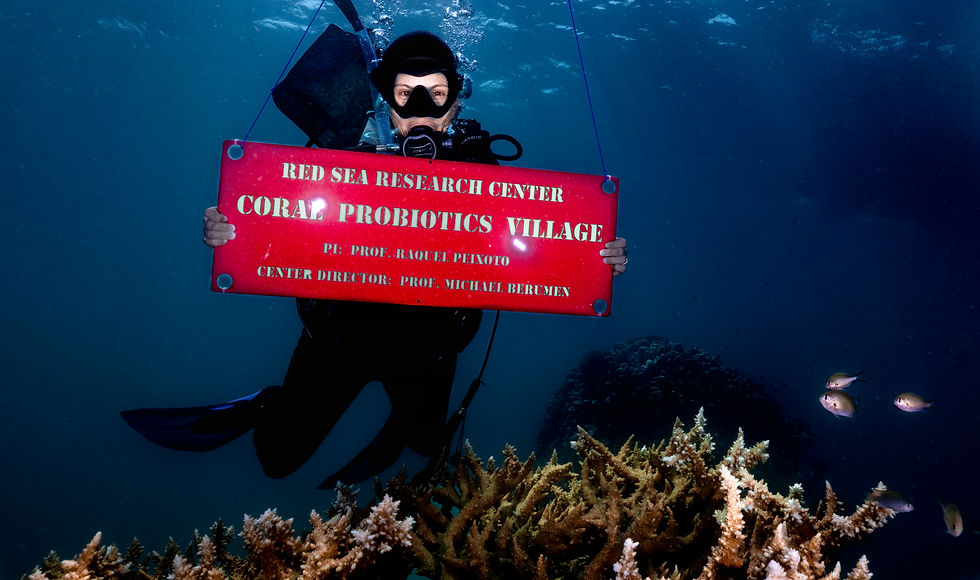
Out of this environment Raquel’s lab grew the Coral Probiotics Village: a mapped underwater “city” complete with gates and streets, designed to organize field experiments. Its shallow depth allows students, school groups and visiting scientists to snorkel through the site, turning active research into a form of public engagement.
The Red Sea’s naturally extreme conditions — temperatures that may resemble future global oceans — make it a true “living laboratory,” drawing increasing international attention to Saudi Arabia’s role in climate and marine science.
Coral Stress and Bleaching
Coral stress is most visible when reefs bleach, but bleaching is only one point along a complex process unfolding inside the coral holobiont: the coral animal and all of its symbiotic partners.
As Raquel explains, microbes are central to this system. “Microbes are important for everything. They shape the planet as we know it. Most living organisms rely on their microbiome for key functions they cannot perform by themselves.”
Under heat stress, the normally cooperative relationship between coral and its symbiotic algae begins to shift. The algae start competing with the coral for nutrients, toxic compounds build up, and the algae either leave or are expelled, taking with them the coral’s primary source of food. Beneficial microbes often collapse as well, replaced by opportunistic pathogens.

Raquel’s team cultures helpful bacteria from healthy corals and reintroduces them during periods of extreme heat. The goal is to stabilize the microbiome long enough for corals to survive until temperatures return to a normal range.
Liza studies the same breakdown from the inside out. Bleaching occurs within an endosymbiosis,“a cell inside another cell.” She notes, making it difficult to determine which partner signals distress first. Her lab tracks short-lived free radicals and stress-response proteins to understand who produces which compounds, and under what conditions.
“We’re trying to understand who makes what chemical signals and when,” she said, because those details may reveal intervention points that reduce cellular collapse.
These scientific questions are inseparable from a more personal one: how do researchers continue this work when bleaching and loss happen so frequently?
Dr. Erika Santoro, a postdoctoral researcher in Raquel’s group, described visiting the same reef week after week and watching familiar coral colonies decline.“It hit me very hard,” she said. “Through our research, we were visiting these reefs daily, and the corals started to feel like a second family.”
Raquel acknowledges that emotional weight, but reframes it as urgency rather than despair.
“I allowed myself one night to be sad,” she recalled of last year’s heatwave. “But we don’t have time for that. I want my kids to grow up in a world with coral reefs. If I can contribute one brick to that wall, I will keep doing it.”
Liza added that hope can also come from identifying “winners and losers” in changing oceans and focusing on places where restoration still has a chance to succeed. Seed banks, restoration plots, and preserved genotypes represent tangible progress, even when the broader picture feels overwhelming.
The Role of Science Communication in Coral Research
So how do we extend that hope beyond the lab and research cohorts?
When research needs to reach wider audiences, scientists often turn to communicators, educators, and artists to help translate complex ideas into something people can relate to. Marine scientist and illustrator Anjleen Hannak describes her approach simply: “I try to explain research through comics, illustrations, colors, and fun framing — making topics more approachable without losing the science.”
See below the carousel by Anjleen on scientific terminologies often used in coral research.
That impulse to make coral science understandable and relevant was shared by both Liza and Raquel in our conversations.
For Liza, outreach often begins with young students. She mentors teams in the international FIRST LEGO League, where middle- and high-school students design LEGO robots around real-world problems. Many choose coral-related challenges, even asking how they might deliver “nanomedicine” to stressed corals. Students can imagine these solutions because they’ve been introduced to a story they connect with.
In Arizona, Liza also hosts lab tours for people who have never seen the ocean. She reminds visitors that their everyday choices, such as buying reef-safe sunscreen and voting with informed opinions,still affect reef futures. She often shares a phrase used to connect people to the Arctic: “It’s not because you’ve never been there that your fingerprints aren’t all over it.”
Raquel’s outreach happens in a very different setting: directly on the reefs of the Red Sea. Her team launched a community contest to name the “streets” of the Coral Probiotics Village. To participate, entrants had to learn why the village exists and why coral conservation matters. Winners joined the research team on a boat, some seeing the ocean for the first time and watched their chosen names installed underwater.
Raquel also explains coral probiotics by comparing them to yogurt and other fermented foods we eat to support our own gut microbiome, making the idea of microbial resilience easier to grasp.
As communication tools evolve, virtual reality is becoming one of the most powerful ways to bring distant ecosystems within reach. These experiences aren’t just visual; they convey scale, movement, and presence in ways traditional media can’t.
Liza noted that ASU is already experimenting with immersive tools through its partnership with Dreamscape Immersive. Students can dive alongside whales or carry out coral restoration exercises, identifying bleached and healthy colonies, growing them in nurseries, and deciding where to replant them.
Raquel’s team is following a similar path, developing a VR simulation of the Coral Probiotics Village so people can explore their underwater research site without entering the waters.
“These experiences don’t replace fieldwork,” Raquel says, “but they remove barriers around who can enter a reef, understand its challenges, and participate in the future of restoration.”
Join the Conversation
Coral science is happening in more places than we might imagine, and understanding it depends on how clearly and creatively we tell these stories. From deserts to digital spaces, studying corals in unconventional settings reveals new insights, but only if the science is communicated in ways people can connect with.
The Experimentalist and ECOS are working together to make coral science more accessible by sharing behind-the-scenes research and bringing scientists, artists and audiences into the conversation. Listen to our Art × Science podcast on Spotify and YouTube, and join the ECOS and The Experimentalist mailing lists to stay connected and take part in future conversations.


Comments